Earlier this year, the government announced a package of support known as the Energy Bills Rebate. As part of this support, council taxpayers who live in a band A to D property will receive a one-off payment of £150 to support rising energy costs. Eligible households who have not received the rebate can now apply via our website. There are also a small number of customers, who pay by Direct Debit and did not automatically receive a payment, who can also complete this online form. Following a form being submitted, we will carry out checks before payment can be made promptly after making a successful application. The government has allocated further funding to help vulnerable households who do not qualify for the Energy Bills Rebate, this will include people on low income in bands E through to H. Further details will be available at the end of June. Anyone struggling with living costs can find support and information on the Citizens Advice website or via our financial assistance page. The Energy Saving Trust also has information on how residents can make their homes more energy-efficient, reduce their carbon emissions and lower their energy bills.
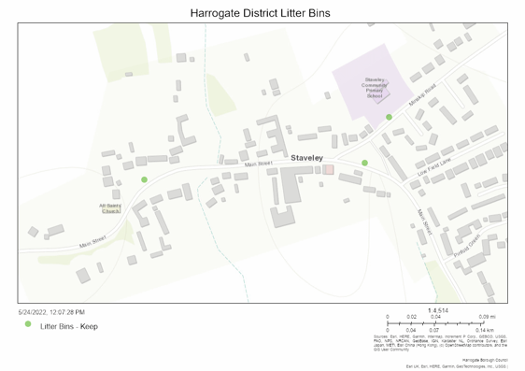
Harrogate Borough Council have contacted the PC to make you aware of proposed changes in Staveley as part of the review of litter bins and locations across the Harrogate district.
Background
In 2020/21 a full audit of our street bin stock and street bin emptying schedules took place across the district. We found that the current service provision is inconsistent and resource intensive resulting in inadequate litterbin provision and staff and vehicles not being deployed efficiently.
Currently the bins emptied are a combination of 80 litre litter and 40 litre dog waste bins which are emptied with different frequencies based on the requirements at the time the bin was installed. The network of bins servicing the district comprises a combination of street bins, parks bins and play area bins all of which were installed at varying times in response to individual requests, planning development or historic placement meaning there is no consistent approach to assessing need or establishing requirements in a standardised way.
Dog bins were installed in the district to address dog-fouling issues and in order for the waste to be separated for disposal. However, this is no longer necessary as bagged dog waste can be placed in litterbins and disposed with in the same way.
Historically, responsibility for servicing the bins was split across the three distinct service areas of Street Cleansing, Refuse and Parks. This has resulted in a resource intensive delivery of service with 16 different operational teams emptying bins across the district. These teams use a variety of fleet ranging from refuse vehicles, transit vans to smaller vans.
The current process has a number of manual handling risks. In a high dog walking area, waste sacks can be of a significant weight or where a refuse vehicle is responsible for emptying a bin, the operative has to manually place the sack in the bin lift area.
We use approximately 270,000 black sacks per year and often empty bins because the bin is on a particular round, not just when they are full.
In summary, the lack of a coordinated approach to provision and servicing of bins has resulted in an inconsistent and resource intensive service that is in need of improvement to allow efficiencies to be realised.
Proposal
The provision and servicing of litter bins needs to be refreshed and modernised to meet the needs of the residents and visitors to the district whilst future proofing the efficiency and resilience of our resources.
Throughout 2022/23 HBC will be implementing a new infrastructure using larger 240 litre wheelie bins in bin housing placed in strategic locations across the district. This new infrastructure means that existing litter and dog bins will be removed and replaced with new provision as appropriate.
The new litter bin guidelines outlines the options that will be considered as appropriate to the different locations.
These changes will have the following key benefits:
• A refreshed and rationalised infrastructure ensuring bins are in the right location and provide sufficient capacity for the area
• Less teams emptying bins freeing up resource to litter pick and cleanse areas, therefore improving the appearance of the district
• Protecting our workforce by reducing the manual handling associated with the existing litter and dog bins
• Removing up to 270,000 black plastic bin bags from our waste stream
• Reducing the use of fossil fuels associated with vehicles for collections
• Introduction of recycling of litter in key areas, therefore reducing items in the litter waste stream.
• Clear guidance to determine new litter bin locations when requested
How does this affect you?
HBC have already spoken to their street cleansing teams who service the area to get their views and feedback on the proposed locations , and have used their knowledge and information to inform the locations being proposed.
However, HBC know that local residents also know and understand their local areas and would like to take the opportunity to ask your views on the proposed locations before making changes. HBC are happy to discuss locations with you and ensure that agreed locations meet the guidance in our litter bin policy and the government’s ‘Right bin right place’ review document of locating bins in public parks, shopping parades, urban centres, lay-bys, villages and popular walking routes.
HBC would like to implement changes during July/August 2022 and therefore please provide any feedback by the 30th June 2022.
If you have any other questions or queries, please don’t hesitate to contact the project team at
Have your say on the proposed changes to Fire and Rescue services in North Yorkshire and York
North Yorkshire Police, Fire and Crime Commissioner Zoë Metcalfe, has launched a three-month consultation to listen the public’s views on proposed changes to fire and rescue services ahead of making her final decisions.
Commissioner Zoë is considering proposals for North Yorkshire Fire and Rescue Service’s new Risk and Resource Model 2022-2025, which sets out how the Service would seek to deploy its people, equipment, and resources. These proposals are based on an extensive risk assessment across North Yorkshire and York, which has identified the likelihood and severity of fires, road traffic collisions, water related incidents, and other emergencies.
North Yorkshire Fire and Rescue Service has a balanced budget, so the proposed changes are not a way to cut costs, but instead are an opportunity to invest in vital areas identified by the public as priorities – such as improving the availability of on-call fire engines in our rural areas, and increasing prevention and protection work across the county and city.
With fire-related incidents making up a smaller proportion of what the Service responds to overall, the proposals include significantly increasing and improving prevention and protection work relating to fire, road and water safety to stop harm happening in the first place, managing response to low-risk automatic fire alarms, introducing a new specialist water rescue capability in Craven, and introducing emergency response principles that make it clearer what the public can expect when making an emergency call.
There are also three proposed changes specifically relating to Harrogate, Scarborough, and the York area.
In the Harrogate and Scarborough areas, there is higher demand for services during daytime hours than at night, and the proposed change of fire engine would offer increased ability to respond during daytime hours, as well as boost resilience more widely.
In York, there is currently more emergency response resource than the risk or demand requires. Huntington fire station is the least used in the area and so the proposal is to change the crewing at this station from full-time to On-call. This proposal would offer appropriate and safe cover for the community, while retaining capacity to carry out important prevention and protection work.
To gather the views of the public, Commissioner Zoë and her team are holding 12 events across North Yorkshire and the city to discuss the proposals, including in Huntington, Harrogate, and Scarborough where specific changes are being proposed. An online questionnaire will also be available to complete throughout the consultation period.
Commissioner Zoë said:
“It’s my job to set the direction of North Yorkshire Fire and Rescue service and therefore consider these proposals and make a decision. Before I do that, I want to know what the public think and I therefore encourage people to come along to one of my consultation events this summer to speak with myself or a member of my team, and to complete the online questionnaire.
“The role of a Fire and Rescue Service has changed and continues to change, with only 26% of our incidents last year relating to a fire emergency. We want to ensure we are addressing our current and future challenges and that we have the capacity to prevent and protect to stop incidents happening in the first place and prevent harm before it can take place, while also having the capacity to respond to emergencies when they do take place. We are confident these proposals would do that.
“Inevitably, there are some areas where the setup of the Service would change but I’m confident the right people, right equipment and the right support would continue to be available to everyone.”
Fire and Rescue personnel across North Yorkshire and York have been engaged by the Service on these proposals over the last two weeks and have been reassured that whilst some roles may be redeployed, everyone would remain employed and continue to fulfil what is needed to keep their community safe and feeling safe.
Jon Foster, Chief Fire Officer said:
“The Risk & Resource Model would support the transformation of our Fire and Rescue Service and enable a greater focus on prevention that is underlined by our assessment of community risk. It would also facilitate increased investment in our on-call service.”
Implementing these proposals would mean Commissioner Zoë could deliver another of the public’s key priorities from her Fire and Rescue Plan consultation – improving the availability of On-call fire engines. The proposals outlined would allow investment of over £1.5 million per year from 2025 to improve North Yorkshire and York On-call station availability.
Further information on the proposals, details on local consultation events and a link to complete the questionnaire can be found on the Commissioner’s website: www.tellcommissionerzoe.co.uk
Below is an article written in response to the release of the White Paper. This was written by a contributor to the Rural Network Services Bulletin. It was also published in the Local Government First periodical this week.
Councillor Cecilia Motley is Chair of the Rural Services Network
Launched with a flurry of grand statements, the ‘Levelling up the UK’ White Paper promised to ‘break the link between geography and destiny, so that no matter where you live you have access to the same opportunities’.
Rural areas in England have long suffered from historical underfunding by successive governments. Rural councils will receive some 37 per cent (£105) per head less in Settlement Funding Assessment than their urban counterparts in 2022/23.
As a result, council tax in rural areas has increased steadily to help balance budgets, with rural residents paying, on average, 21 per cent (£104) per head more than those in urban areas.
Everyone can support the White Paper’s four headline aims: to boost productivity, spread opportunity, restore a sense of pride and belonging, and empower local leaders and communities. It’s how these will be delivered and monitored in a rural context that is missing.
Productivity in rural areas is 83 per cent of that for England as a whole, with predominantly rural areas accounting for 22 per cent of the population, but contributing around 15 per cent economically.
The high cost of housing in rural areas, combined with lower average wages and the significantly higher fuel-poverty gap in which many rural households find themselves, has created a perfect storm for the current cost-of-living crisis.
“Funding to meet change on the scale envisaged is not set out clearly”
Funds available as part of the levelling up agenda should assess the standards of living achievable in different locations given local labour market conditions, to distribute funding to those areas in need.
The measures and metrics in the White Paper need to be available at a suitably micro level to enable the pockets of deprivation in rural areas to be acknowledged with support targeted appropriately.
Using county or regional averages often masks smaller clusters, which are either ignored or left behind in any policy interventions. The Government must acknowledge the differentials within rural areas that need to be addressed.
The White Paper is light on details regarding which bodies will be charged with delivery. Local government will clearly have a key role to play, but additional funding to meet change on the scale envisaged is not set out clearly, nor is the current funding gap addressed.
While we welcome the focus on digital connectivity and improved mobile connectivity, this is almost the only place in the whole document that makes substantive reference to rural areas.
Unfortunately, there is a long history of broken promises in relation to access to high-quality broadband for rural areas.
There is real concern that the Government could achieve many of its 12 missions set out in the White Paper without addressing the pressing challenges that rural communities face around the increased cost of service delivery, productivity, wage levels, the ageing demographic, access to skills, training and transport, and a social care sector on its knees.
Can the White Paper deliver levelling up for rural areas? It can, but it needs to measure the current status quo at the right level, and introduce targeted interventions, delivered locally, that meet rural challenges and enable our rural areas to achieve their full potential. Unless such efforts are made, the verdict on the levelling up White Paper from the rural perspective will be ‘could do better’. This would be a serious lost opportunity to transform rural services.
Introducing the Anne Robson Helpline – if you or someone close to you is dying, you can talk to someone.
At the Anne Robson Trust we aim to be there to listen to anyone who faces dying or the imminent death of someone they care about. We know that facing the end of life can leave you feeling isolated and alone.
Being able to access support is so important. Gaining knowledge of what may happen towards the end of life and being prepared helps both the person dying and their loved ones to feel a sense of control.
Calls are free and confidential. Call us on 0808 801 0688 – we have time to talk
This new Carers’ Resource project will offer additional group support to male carers, over and above existing services, to provide a inclusive and beneficial range of activities for male carers.
New activity groups will begin this spring and summer, including allotment groups, fishing trips, walking groups and supper clubs.
There will also be an online group for the Harrogate area, providing group support to male carers. A male carers’ forum will meet regularly, and a number of trips away are also planned.
Carers’ Resource will also be producing specific information resources for male carers, including information on men’s physical and mental health.
To join the ‘Men Care Too’ project or for more info, call 0808 501 5939 or email mencare2@carersresource.org
A community cycling support group – everyone is welcome and the group is ideal for those who are new to cycling – maybe you’re feeling a bit stressed out, or you’re going through some tough times right now. Fresh air, a fresh perspective on life, supportive friendships, cafe stop, a sense of pride and endorphins thrown in for free!
Sunday Afternoon Rides have now started every Sunday at 1.30pm until October. Free rides and free bikes to loan, great for beginners.
Description: 2 signs indicating entry to Copgrove, 1 on Wath Lane and 1 on Apron Lane.
Estimated Value: £710
Acquisition: Purchased in November 2020 and installed in February 2021.
Locations:
Wath Lane – Grid Reference:
Apron Lane – Grid Reference:
Recreation Field
Description: Enclosed field of public open space with a fenced children’s play area and small football pitch.
Location: Arkendale Road, Staveley. Grid Reference: SE
Rented From: Staveley Relief in Need Charity Rental Fee: £70 per annum
Allotments
Description: 2 allotment plots leased annually to local residents.
Location: Arkendale Road, Staveley. Grid Reference: SE
Rented From: Harrogate Borough Council Rental Fee: £40 per annum per site Lease Agreement
Posts & Chains
Description: A row of posts and chains along the edge of the village green west and the unmade road in front of the Royal Oak pub, acting as a barrier to prevent car parking on the green.
Location: Village Green West, Main Street, Staveley. Grid Reference: SE 363 627
Acquisition
Date: Not known Cost: £665
Current Use: Boundary fence
Notice Boards
Description: 3 village notice boards at various locations around the two villages.
Total Estimated Value: £1,425
Notice Boards 1 and 2
Location: Village Green East, Main Street, Staveley. Grid Reference: SE 366 627
Estimated Value: £950
Acquisition: 1997 and 2005/6
Key Holder(s): Bill Kirkpatrick, Neil Horton
Notice Board 3
Location: Start of St. Mongah’s Lane, Copgrove. Grid Reference: SE 345 632
Estimated Value: £475
Acquisition: 2002
Key Holder(s): Peter Edwards
Safety Barrier
Description: Safety barrier alongside the pull-in in front of the primary school. The Parish Council financed the barrier following the withdrawal of funds by North Yorkshire County Council.
Location: In front of primary school, Minskip Road, Staveley. Grid Reference: SE 366 628
Acquisition
Date: November 2011 Cost: £550
Current Use: Public safety barrier
Childrens Playground
Description: Childrens Playground, located on the recreation field comprising the following equipment items:
Wicksteed Whirly Bird
Record Cradle Swings
Record Flat Seat Swings
Hags Multi Pondo
Play and Leisure Multi Unit
Play and Leisure Fish Spring Mobile
Ledon Car Spring Mobile
Bench
Fencing and Gates
The playground is inspected annually by RoSPA and four times per year by a local specialist contractor. It is also visually inspected weekly by a team of local volunteers and stands on land rented annually from the Staveley Relief in Need Charity.
More information about the development of the childrens play area is available here. Maintenance of the playground is one of the Parish Council’s ongoing projects. Progress on the project can be seen by selecting the Children’s Play Area project page.
Location: Arkendale Road, Staveley. Grid Reference: SE 366 625
Acquisition: Adopted .
Estimated Value: £12,000
Bus Shelter
Description: Coated steel frame, clear screen shelter with 4 seats
Location: On village green east, Main Street, Staveley. Grid Reference: SE 366 627
Acquisition: January 2012. Purchased by the Parish Council, thanks to a donation from Abacus, a local employer based at Jubilee Court, Copgrove.
Description: Ex BT telephone box, now home to the village public defibrillator unit. The phobe box is a K6, designed by Sir Giles Gilbert Scott in 1936 and introduced to celebrate the King George V Silver Jubilee. It was probably installed under the ‘Jubilee Concession’, which meant kiosks were installed in every town and village with a Post Office. The K6 was 80 years old in 2016.
Location: Opposite the village green east, Main Street, Staveley. Grid Reference: SE 366 627
Acquisition: Phone box purchased from BT in May 2016 for a nominal sum of £1. The defibrillator was purchased from Wel Medical Ltd. and installed in June 2016.
Cost: £1,800 Current Valuation: Defibrillator £1,800. Replacement cost of K6 approx £2,500 plus delivery and installation.
Further Information:The defibrillator is checked weekly by the local Community First Responders coordinator. See Community First Responders for more details on how to use the unit.
Wooden Benches
Description: 5 wooden benches at various locations around the two villages.
Estimated Value: £1,900 for benches 1 – 4
Bench No. 1
Location: Wath Lane, Staveley. Grid Reference: SE 359 625
Acquisition: 1995
Bench No. 2
Location: Village Green West, Staveley. Grid Reference: SE 363 627
Acquisition: 1995
Bench No. 3
Location: Village Green West, Staveley. Grid Reference: SE 363 627
Acquisition: 1995
Bench No. 4
Location: Main Street, Staveley. Grid Reference: SE 365 627
Acquisition: 1995
Bench No.5
This seat was removed in 2020.
Location: Arkendale Road, Staveley. Grid Reference: SE 368 624
Bench No.6
Location: Open space on St. Mongah’s Lane, Copgrove. Grid Reference: SE 345 633
Estimated Value: £475
Acquisition: 2002
Stone Bench
Description: Wooden bench set within a stone surround.
Location: Junction of Main Street, Minskip Road and Arkendale Road, Staveley. Grid Reference: SE 366 627
Acquisition:
Estimated Value: £2,375
From the Archive: The seat when new in 1990
The Pinfold
Description: An animal pound where stray livestock were impounded. Animals were kept in a dedicated enclosure, until claimed by their owners, or sold to cover the costs of impounding. The term pinfoldis saxon in origin and common in the north of England. A village pound was a feature of most English medieval villages.
Location: Arkendale Road, Staveley. Size: approx 250 sq mt including the adjacent land. Grid Reference: SE 367 626
Acquisition: Erected in 1832 by public subscription and restored in 1986. Date: Not known Cost: £20,470 Current Valuation: £20,470
Current Use: Public amenity
Further Information: In 2012, thanks to an initiative by Staveley resident Ken Barker, a rose garden was planted in land next to the Pinfold to commemorate the Queen’s Diamond Jubilee. In 2019 a new gate to the Pinfold was installed by D.Hargreaves (Blacksmith) of The Forge, Coneythorpe.
Village Green East
Description: Former allotment site, purchased from the estate of F.L. Knowlson. A copy of the deed of conveyance is available here.
Location: Junction of Main Street, Minskip Road and Arkendale Road, Staveley. Size: Grid Reference: SE 366 627
Acquisition
Date: 2nd September 1986 Cost: £750 Current Valuation: £750
Current Use: Public open space
From the Archive: Oak Tree Planting
Village Green West
Description: Triangle of land registered to the Parish Council under Section 3 of the Commons Registration Act 1965 when no evidence of ownership was offered to the Commissioner at a hearing in Harrogate on 31st October 1973. A copy of the decision notice is available here.
Location: In front of the Royal Oak pub Main Street, Staveley Size: Grid Reference: SE 363 627
Acquisition
Date: 9th November 1973 Cost: £0 Current Valuation: